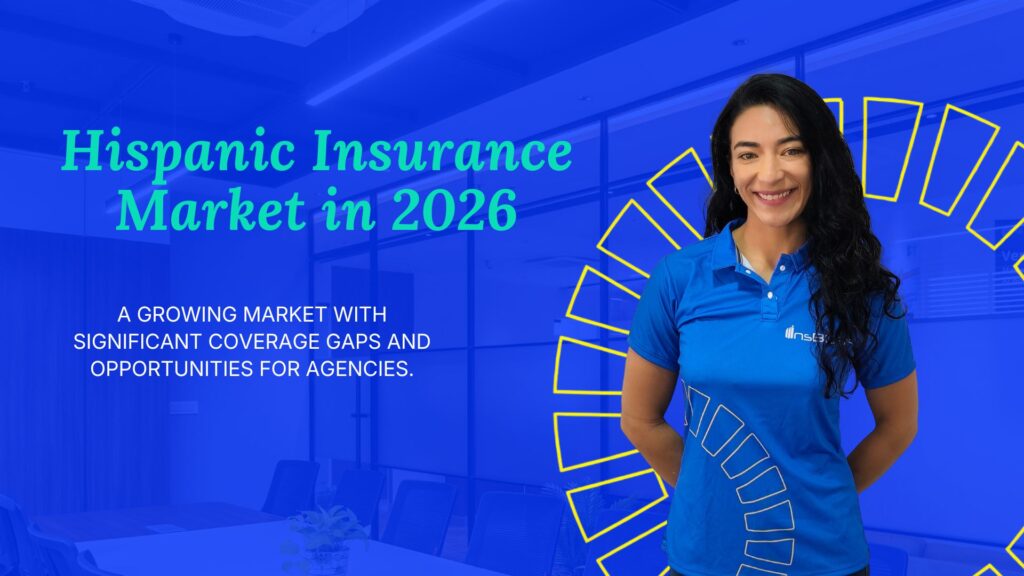
The US Hispanic Insurance Market in 2026: Size & Growth

Where Insurance Agencies Actually Fall Behind on Renewals
The US Hispanic market has grown to 70.1 million people and represents a $4 trillion economy, yet insurance ownership continues to lag behind its economic and population growth. For independent agencies, the data highlights an opportunity to better serve Hispanic clients through targeted, Spanish-speaking support that addresses language barriers and coverage misconceptions.

Share This Post

About the Author

  • InsBOSS Marketing is the official content team at InsBOSS, publishing educational articles, company updates, and industry insights focused on insurance outsourcing, agency operations, virtual staffing, and business growth.

The US Hispanic Insurance Market in 2026: Size & Growth

The US Hispanic population reached 70.1 million as of July 2025, which represents 21 percent of the country, according to the US Census Bureau. The Hispanic economy has grown alongside it, reaching $4 trillion in GDP, large enough to rank as the world’s fifth-largest economy on its own. Insurance ownership hasn’t kept pace with either number. This is what the sourced data actually shows, and what it means for agencies.

Want to see what this market looks like for your agency specifically? Download our pricing guide and start the conversation.

How Big Is the US Hispanic Market Right Now?

The US Census Bureau’s Vintage 2025 Population Estimates, released August 2026, put the Hispanic population at 70.1 million as of July 1, 2025, making it the nation’s largest racial or ethnic minority at 21 percent of the total US population. Looking further out, Census Bureau population projections indicate the Hispanic share of the population will keep climbing, reaching roughly 27 percent by 2060.

The economic weight behind that population has grown just as fast. According to the Insurance Information Institute (Triple-I), citing the Latino Donor Collaborative’s official US Latino GDP Report, Latino GDP reached $4 trillion in 2023, up from $2.1 trillion in 2015, ranking as the world’s fifth-largest economy if measured independently. Latino consumer spending alone reached $2.7 trillion in 2023, larger than the entire economies of Texas or New York. Triple-I also reports that Latinos drove 30.6 percent of total US GDP growth between 2019 and 2023, despite making up roughly 20 percent of the population.

Why Is This Market Still Underinsured?

Despite that growth, insurance ownership hasn’t caught up. LIMRA and Life Happens’ 2024 Insurance Barometer Study found only 43 percent of Hispanics report having life insurance, the lowest ownership rate of any racial or ethnic group measured in the study. The gap doesn’t appear to come from a lack of perceived need. The same study found 53 percent of Hispanics say they need, or need more, life insurance, 11 points higher than the general population.

Cost perception plays a real role. Forty-four percent of Hispanic respondents said they feel life insurance is too expensive, and 72 percent overestimate the actual cost of a term life policy. Twenty-six percent believe coverage is only meant to cover final expenses, a misconception likely to steer people away from broader financial protection they might otherwise consider.

Behind each of those numbers is a family that thinks they’re protected when they’re not, or one that’s avoiding a conversation they assume they can’t afford. That’s not just a market gap. It’s a real coverage gap sitting inside client relationships an agency may already have, not just new business waiting to be found.

The industry has acknowledged its own part in this gap. Triple-I’s reporting on a survey conducted by Marsh and the Latin American Association of Insurance Agencies (LAAIA) found just over half of insurance professionals surveyed believed their own companies were genuinely invested in attracting Hispanic customers. Nearly two-thirds said insurers don’t employ enough Latino staff, and 84 percent agreed Latinos are underrepresented in senior management across the industry.

Does Spanish-speaking Service Actually Change Outcomes?

The honest answer is that it depends on which part of the market, and the data is more nuanced than “hire Spanish speakers and you’re done.” Pew Research Center’s analysis of 2019 Census Bureau data found seven in ten Hispanics ages 5 and older spoke Spanish at home. Even among US-born Hispanics, where English proficiency runs high at 91 percent, 57 percent still spoke Spanish at home in 2019. Adapting to English clearly does not mean leaving Spanish behind.

Generation matters more than ethnicity alone, and it cuts in a direction worth noting for insurance specifically. Pew’s research on language use across immigrant generations shows first-generation and older Hispanics remain the most Spanish-dominant group, even as younger, later generations lean more English-dominant. That is also the group agencies most need to reach well: older Hispanics are typically further along in their careers, more likely to own a home or be supporting a growing family, and more likely to need the kind of coverage, life insurance especially, that this data shows the market is still missing.

What this means practically: Spanish-speaking service is not a blanket requirement for every Hispanic household, but for immigrant, first-generation, and older clients specifically, being served in their second language is not a minor inconvenience. A coverage exclusion or a renewal notice misunderstood in a non-native language is a real gap for that client, not a service preference. An agency offering Spanish-speaking support is closing that specific gap, not applying a broad label to a market that is not uniform.

Curious how Spanish-speaking support could fit your agency’s specific client base? Book a consultation and we’ll talk through it.

What This Means for Independent Agencies

Here’s a concrete way to use this data rather than just read it: check whether your Hispanic client share roughly tracks the Hispanic population share in the areas you serve. If it doesn’t, that’s not a vague impression, it’s a measurable gap, and the data above suggests part of it comes down to cost misconceptions and language barriers your agency can actually address, not factors outside your control.

This is the gap our Spanish-speaking virtual assistant service is built around. InsBOSS VAs handle up to 90 percent of back office work, from applications, quoting, binding, policy issuance, and renewals, all in Spanish when that is what the client needs, so nothing gets lost in translation at the moments that matter most. Pricing runs a fraction of what a local hire costs once salary, benefits, and turnover are factored in, and every VA comes with a full support team (a Client Experience Manager, quality control, IT, and a backup VA) at no additional cost. That level of built-in oversight is not standard across this space, and it matters most on the accounts that are hardest to replace if something goes wrong.

The Bottom Line

The US Hispanic market is large, economically significant, and still growing, and insurance ownership hasn’t caught up, a gap the industry has documented and openly acknowledged. For independent agencies willing to offer real, targeted Spanish-speaking service where the data shows it’s actually needed, that gap remains genuinely open.

If you want to talk through what this market looks like for your agency, download our pricing guide or reach out to InsBOSS directly. Or go straight to the source: see how our Spanish-speaking VA service works and what it can take off your plate.

Frequently Asked Questions

The US Hispanic population reached 70.1 million as of July 2025, 21 percent of the country, according to the US Census Bureau. The broader Latino economy reached $4 trillion in GDP in 2023, per the Latino Donor Collaborative.

Cost perception plays a major role. LIMRA’s 2024 Insurance Barometer Study found 44 percent of Hispanics feel life insurance is too expensive and 72 percent overestimate its actual cost. The industry itself has also acknowledged underinvestment in reaching this market.

Yes. The Census Bureau’s long-range population projections show the Hispanic share of the US population climbing from about 19 percent today to roughly 27 percent by 2060.


It matters most for immigrant and first-generation Hispanic households. Pew Research Center data shows Spanish-at-home use is far more common among the foreign-born than among US-born Hispanics, where English use dominates by the second and third generations.

About seven in ten Hispanics ages 5 and older spoke Spanish at home as of 2019, per Pew Research Center’s analysis of Census data, though that share has declined from a peak of 78 percent in 2000 and is notably lower among US-born Hispanics specifically.

About the Author
  • InsBOSS Marketing is the official content team at InsBOSS, publishing educational articles, company updates, and industry insights focused on insurance outsourcing, agency operations, virtual staffing, and business growth.

About the Author

  • InsBOSS Marketing is the official content team at InsBOSS, publishing educational articles, company updates, and industry insights focused on insurance outsourcing, agency operations, virtual staffing, and business growth.

The US Hispanic Insurance Market in 2026: Size & Growth

The US Hispanic population reached 70.1 million as of July 2025, which represents 21 percent of the country, according to the US Census Bureau. The Hispanic economy has grown alongside it, reaching $4 trillion in GDP, large enough to rank as the world’s fifth-largest economy on its own. Insurance ownership hasn’t kept pace with either number. This is what the sourced data actually shows, and what it means for agencies.

Want to see what this market looks like for your agency specifically? Download our pricing guide and start the conversation.

How Big Is the US Hispanic Market Right Now?

The US Census Bureau’s Vintage 2025 Population Estimates, released August 2026, put the Hispanic population at 70.1 million as of July 1, 2025, making it the nation’s largest racial or ethnic minority at 21 percent of the total US population. Looking further out, Census Bureau population projections indicate the Hispanic share of the population will keep climbing, reaching roughly 27 percent by 2060.

The economic weight behind that population has grown just as fast. According to the Insurance Information Institute (Triple-I), citing the Latino Donor Collaborative’s official US Latino GDP Report, Latino GDP reached $4 trillion in 2023, up from $2.1 trillion in 2015, ranking as the world’s fifth-largest economy if measured independently. Latino consumer spending alone reached $2.7 trillion in 2023, larger than the entire economies of Texas or New York. Triple-I also reports that Latinos drove 30.6 percent of total US GDP growth between 2019 and 2023, despite making up roughly 20 percent of the population.

Why Is This Market Still Underinsured?

Despite that growth, insurance ownership hasn’t caught up. LIMRA and Life Happens’ 2024 Insurance Barometer Study found only 43 percent of Hispanics report having life insurance, the lowest ownership rate of any racial or ethnic group measured in the study. The gap doesn’t appear to come from a lack of perceived need. The same study found 53 percent of Hispanics say they need, or need more, life insurance, 11 points higher than the general population.

Cost perception plays a real role. Forty-four percent of Hispanic respondents said they feel life insurance is too expensive, and 72 percent overestimate the actual cost of a term life policy. Twenty-six percent believe coverage is only meant to cover final expenses, a misconception likely to steer people away from broader financial protection they might otherwise consider.

Behind each of those numbers is a family that thinks they’re protected when they’re not, or one that’s avoiding a conversation they assume they can’t afford. That’s not just a market gap. It’s a real coverage gap sitting inside client relationships an agency may already have, not just new business waiting to be found.

The industry has acknowledged its own part in this gap. Triple-I’s reporting on a survey conducted by Marsh and the Latin American Association of Insurance Agencies (LAAIA) found just over half of insurance professionals surveyed believed their own companies were genuinely invested in attracting Hispanic customers. Nearly two-thirds said insurers don’t employ enough Latino staff, and 84 percent agreed Latinos are underrepresented in senior management across the industry.

Does Spanish-speaking Service Actually Change Outcomes?

The honest answer is that it depends on which part of the market, and the data is more nuanced than “hire Spanish speakers and you’re done.” Pew Research Center’s analysis of 2019 Census Bureau data found seven in ten Hispanics ages 5 and older spoke Spanish at home. Even among US-born Hispanics, where English proficiency runs high at 91 percent, 57 percent still spoke Spanish at home in 2019. Adapting to English clearly does not mean leaving Spanish behind.

Generation matters more than ethnicity alone, and it cuts in a direction worth noting for insurance specifically. Pew’s research on language use across immigrant generations shows first-generation and older Hispanics remain the most Spanish-dominant group, even as younger, later generations lean more English-dominant. That is also the group agencies most need to reach well: older Hispanics are typically further along in their careers, more likely to own a home or be supporting a growing family, and more likely to need the kind of coverage, life insurance especially, that this data shows the market is still missing.

What this means practically: Spanish-speaking service is not a blanket requirement for every Hispanic household, but for immigrant, first-generation, and older clients specifically, being served in their second language is not a minor inconvenience. A coverage exclusion or a renewal notice misunderstood in a non-native language is a real gap for that client, not a service preference. An agency offering Spanish-speaking support is closing that specific gap, not applying a broad label to a market that is not uniform.

Curious how Spanish-speaking support could fit your agency’s specific client base? Book a consultation and we’ll talk through it.

What This Means for Independent Agencies

Here’s a concrete way to use this data rather than just read it: check whether your Hispanic client share roughly tracks the Hispanic population share in the areas you serve. If it doesn’t, that’s not a vague impression, it’s a measurable gap, and the data above suggests part of it comes down to cost misconceptions and language barriers your agency can actually address, not factors outside your control.

This is the gap our Spanish-speaking virtual assistant service is built around. InsBOSS VAs handle up to 90 percent of back office work, from applications, quoting, binding, policy issuance, and renewals, all in Spanish when that is what the client needs, so nothing gets lost in translation at the moments that matter most. Pricing runs a fraction of what a local hire costs once salary, benefits, and turnover are factored in, and every VA comes with a full support team (a Client Experience Manager, quality control, IT, and a backup VA) at no additional cost. That level of built-in oversight is not standard across this space, and it matters most on the accounts that are hardest to replace if something goes wrong.

The Bottom Line

The US Hispanic market is large, economically significant, and still growing, and insurance ownership hasn’t caught up, a gap the industry has documented and openly acknowledged. For independent agencies willing to offer real, targeted Spanish-speaking service where the data shows it’s actually needed, that gap remains genuinely open.

If you want to talk through what this market looks like for your agency, download our pricing guide or reach out to InsBOSS directly. Or go straight to the source: see how our Spanish-speaking VA service works and what it can take off your plate.

Frequently Asked Questions

The US Hispanic population reached 70.1 million as of July 2025, 21 percent of the country, according to the US Census Bureau. The broader Latino economy reached $4 trillion in GDP in 2023, per the Latino Donor Collaborative.

Cost perception plays a major role. LIMRA’s 2024 Insurance Barometer Study found 44 percent of Hispanics feel life insurance is too expensive and 72 percent overestimate its actual cost. The industry itself has also acknowledged underinvestment in reaching this market.

Yes. The Census Bureau’s long-range population projections show the Hispanic share of the US population climbing from about 19 percent today to roughly 27 percent by 2060.


It matters most for immigrant and first-generation Hispanic households. Pew Research Center data shows Spanish-at-home use is far more common among the foreign-born than among US-born Hispanics, where English use dominates by the second and third generations.

About seven in ten Hispanics ages 5 and older spoke Spanish at home as of 2019, per Pew Research Center’s analysis of Census data, though that share has declined from a peak of 78 percent in 2000 and is notably lower among US-born Hispanics specifically.

About the Author

  • InsBOSS Marketing is the official content team at InsBOSS, publishing educational articles, company updates, and industry insights focused on insurance outsourcing, agency operations, virtual staffing, and business growth.

Want to Read More? Just Fill This Out.

Get useful insurance back office tips, industry updates, and expert insights at your fingertips.

Blogs Form

Explore More Industry Updates:

Get The Freedom To Do More!

Book a FREE 30-minute consultation with us to learn more about how we can help you reclaim more time to grow your insurance agency.

Myth #3: Support Concerns Stop Progress
Search